

Professional Interior Logo Design Guide for Beginners: Everything You Need to Know in 2026
Master the art of interior logo design in 2026 with this complete beginner-friendly guide covering AI-powered tools, modern design principles, color psychology, typography trends, and a step-by-step creation process.
Introduction: Why Interior Logo Design Matters More Than Ever in 2026
Your interior logo design is the very first thing potential clients notice about your brand. Before they walk into your showroom, before they browse your portfolio, and before they read a single review — they encounter your visual identity. Therefore, getting your logo right in 2026 isn’t just about aesthetics. It’s fundamentally about business survival in an increasingly competitive market.
The interior design industry has grown by 35% since 2023, and consequently, standing out requires more than just great design work. Moreover, a well-crafted brand mark communicates your style, expertise, and personality within seconds — making it your most powerful silent salesperson.
However, most beginners feel overwhelmed by the logo creation process. They don’t know where to start, which tools to use, or what principles to follow. As a result, they end up with generic visual identities that fail to represent their unique brand.
This comprehensive guide solves that problem entirely. Whether you’re launching a new interior design business in 2026 or rebranding an existing one, this guide will walk you through everything step by step. Additionally, we’ll cover the latest AI-powered tools and design trends reshaping how logos are created. By the end, you’ll have the knowledge and confidence to create a brand mark that truly represents you.
What Is Interior Logo Design and Why Does It Matter?
Before diving into the creation process, let’s clearly define what interior logo design means in today’s context. Simply put, it’s the process of creating a visual symbol or mark that represents an interior design business, studio, or professional.
However, creating a logo for your design firm goes far beyond drawing a pretty picture. In fact, it involves strategic thinking about brand positioning, target audience, design philosophy, digital presence, and market differentiation.
How Interior Logo Design Has Changed in 2026
The branding landscape has evolved significantly compared to previous years. First, AI-powered tools have democratized the design process, making professional visual identities accessible to everyone. Second, the rise of social media has created new requirements for logo versatility across dozens of digital platforms.
Furthermore, clients in 2026 expect brands to have cohesive visual identities across every touchpoint — from Instagram Reels to virtual reality showrooms. Therefore, modern brand marks must be more adaptable and versatile than ever before.
Additionally, sustainability and authenticity have become core brand values. As a result, your visual identity must communicate these principles while remaining distinctive and memorable.
Key Elements That Make Interior Logo Design Effective
Every successful brand mark for interior designers contains these fundamental elements:
| Element | Purpose | 2026 Considerations |
|---|---|---|
| Symbol/Icon | Visual representation of the brand | Must work as AR/VR element |
| Typography | The text/font spelling the brand name | Variable fonts gaining popularity |
| Color Palette | Colors defining the brand mood | Accessibility compliance required |
| Tagline (Optional) | Short phrase describing services | SEO-optimized for voice search |
| Animation (New) | Motion version for digital platforms | Essential for social media |
| Responsive Versions | Different sizes for platforms | Mandatory for multi-platform presence |
| Negative Space | Empty space adding elegance | Creates hidden meanings and depth |
Why Your Business Needs Professional Interior Logo Design
You might wonder whether investing time into your visual identity is truly necessary when AI can generate logos in seconds. The answer is absolutely yes — but the reasons have evolved.
1. First Impressions Happen Faster Than Ever
Research from 2025 shows that people form opinions about a brand within 3-5 seconds of first contact. Consequently, your brand mark must instantly communicate professionalism, creativity, and trustworthiness.
Moreover, potential clients now compare interior designers across multiple platforms simultaneously. Therefore, a polished visual identity gives you an immediate advantage in a market where attention spans continue to shrink.
2. Digital-First Brand Recognition
In 2026, approximately 78% of interior design clients discover designers through digital channels. As a result, your logo appears on screens far more often than on paper.
Furthermore, consistent usage across all digital touchpoints reinforces brand recognition exponentially. Meanwhile, the rise of voice search and AI assistants means your visual brand needs to be even more distinctive.
3. Communicating Your Design Philosophy Instantly
Your brand mark silently communicates your design style and philosophy. For instance, a minimalist logo with clean lines suggests modern, contemporary aesthetics. Meanwhile, an ornate, detailed mark implies classical, luxurious sensibilities.
Additionally, the colors, fonts, shapes, and animation style tell a complete story about your approach. Therefore, your visual identity should align perfectly with your portfolio.
4. AI-Saturated Market Demands Authenticity
Ironically, as AI makes generic logos easier to create, the value of authentic, thoughtfully designed brand marks has increased dramatically. Clients in 2026 can spot AI-generated generic logos instantly.
Moreover, an obviously templated logo signals that a designer doesn’t care enough about their own brand. Consequently, investing in genuine, custom visual identity has become a trust-building necessity.
5. Multi-Platform Versatility Is Non-Negotiable
In 2026, your logo must work across an ever-expanding list of platforms:
- Traditional platforms (business cards, signage, stationery)
- Social media (Instagram, TikTok, Pinterest, LinkedIn, YouTube)
- Emerging platforms (AR/VR experiences, holographic displays)
- AI assistants (visual brand cards, smart home interfaces)
- Web3 applications (NFT portfolios, metaverse showrooms)
Therefore, versatility isn’t just nice-to-have — it’s essential for business survival.
Interior Logo Design Styles That Work Best in 2026
Understanding different style options helps you choose the right approach for your brand. Below are the most popular and emerging styles for interior logo design that professionals are using today.

1. Neo-Minimalist Interior Logo Design
Neo-minimalism has evolved beyond simple minimalism to become the dominant trend in 2026. This approach combines extreme simplicity with subtle warmth and personality.
Characteristics:
- Ultra-clean compositions with intentional imperfections
- Limited color palette (usually 1-2 colors) with warm undertones
- Refined geometric shapes with organic softening
- Generous white/negative space with purposeful balance
- Variable weight typography that feels human yet precise
Best For: Modern interior designers, Scandinavian style specialists, contemporary studios
Why It Works: These logos communicate sophistication while feeling approachable. Moreover, they reproduce beautifully across all digital and physical mediums.
2. Quiet Luxury Style
The luxury approach in 2026 has shifted toward understated elegance rather than obvious opulence.
Characteristics:
- Restrained, elegant serif or custom typography
- Muted luxury tones (soft gold, deep charcoal, dusty rose, sage)
- Subtle refined details rather than ornate decoration
- Premium feel through quality of execution, not complexity
- Modernized monogram or crest elements
Best For: High-end residential designers, luxury hospitality designers, premium commercial interiors
Why It Works: The quiet luxury movement has redefined premium branding. Consequently, logos that whisper luxury rather than shouting it attract today’s sophisticated clients.
3. Geometric and Architectural Style
Geometric designs continue to be relevant, with new emphasis on 3D elements and spatial depth.
Characteristics:
- Clean geometric shapes with dimensional qualities
- Isometric and 3D-inspired compositions
- Symmetrical designs with subtle asymmetric breaks
- Architectural line work with depth perception
- Modern, structured feel with technological sophistication
Best For: Architectural interior designers, commercial space designers, design-build firms
4. Biophilic and Organic Style
Nature-inspired branding has emerged as a major trend, reflecting the growing emphasis on nature-connected spaces.
Characteristics:
- Flowing, organic lines inspired by natural forms
- Botanical and natural material references
- Earth tones with fresh green accents
- Hand-crafted or artisanal aesthetic qualities
- Sustainable, authentic, grounded feel
Best For: Sustainable designers, biophilic specialists, wellness-focused studios
5. Typographic Style
Typography-driven logos rely primarily on creative font work rather than symbols. In 2026, this approach has become even more sophisticated with variable fonts.
Best For: Personal brand designers, boutique studios, design consultancies
6. Animated and Motion Style
Animated branding has become essential in 2026 as video content dominates digital platforms.
Best For: All designers with active digital presence
7. AI-Collaborative Style
A completely new category in 2026, this approach combines human creativity with AI-generated elements for unique results.
Interior Logo Design Style Comparison Chart
| Style | Best For | Mood | Digital Readiness | Timelessness |
|---|---|---|---|---|
| Neo-Minimalist | Modern designers | Clean, warm | Excellent | Very High |
| Quiet Luxury | Premium designers | Understated elegance | Very Good | High |
| Geometric 3D | Architectural designers | Structured | Excellent | High |
| Biophilic | Eco designers | Natural, grounded | Good | Medium-High |
| Typographic | Personal brands | Distinctive | Very Good | Very High |
| Animated | Digital-first brands | Dynamic | Excellent | Medium |
| AI-Collaborative | Innovation leaders | Cutting-edge | Excellent | Medium |
Interior Logo Design Color Psychology for 2026
Color selection is one of the most critical decisions when creating your brand identity. Colors trigger emotional responses and communicate specific messages. Therefore, choosing the right palette can make or break your logo’s effectiveness.
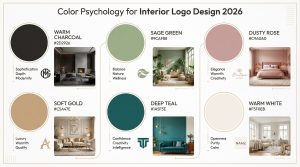
Best Colors for Interior Logo Design
Warm Charcoal: The New Black
Warm charcoal has replaced pure black as the most sophisticated choice for design professionals.
- Psychology: Sophistication, warmth, depth, modernity
- HEX Examples: #2D2926, #36332F, #3C3835
- Best paired with: Warm gold, cream, sage green, dusty rose
- Ideal for: Contemporary designers, modern luxury brands
Sage Green: Nature Meets Sophistication
Sage green has emerged as the defining color for design brands in 2026, reflecting biophilic design’s mainstream adoption.
- Psychology: Balance, nature, tranquility, growth, wellness
- HEX Examples: #9CAF88, #8B9F7B, #87986A
- Best paired with: Cream, warm charcoal, terracotta, soft gold
- Ideal for: Sustainable designers, wellness-focused studios
Soft Gold: Quiet Luxury
Muted, soft gold has replaced bright metallic gold in branding trends.
- Psychology: Understated luxury, warmth, quality, timelessness
- HEX Examples: #C5A47E, #BFA87E, #D4B896
- Best paired with: Warm charcoal, deep navy, forest green
- Ideal for: Premium brands, luxury residential designers
Dusty Rose: Modern Neutral
Dusty rose has become a sophisticated neutral, moving beyond gendered associations.
- Psychology: Modern elegance, warmth, approachability, creativity
- HEX Examples: #C9A0A0, #D4A5A5, #CBAAA7
- Best paired with: Charcoal, sage green, warm white
- Ideal for: Boutique studios, residential designers
Deep Teal: Confident Creativity
Deep teal combines trustworthiness with creativity, making it popular for design firms.
- Psychology: Confidence, creativity, depth, intelligence
- HEX Examples: #1A5F5E, #2D6A6A, #1B6B6B
- Best paired with: Warm gold, cream, copper
- Ideal for: Creative studios, commercial designers
Warm White: The Essential Base
Warm white has replaced cool white as the preferred background color.
- Psychology: Openness, purity, space, calm
- HEX Examples: #F5F0EB, #FAF6F1, #F8F4EF
- Ideal for: All brands as a foundation color
Interior Logo Design Color Palette Examples
| Brand Type | Primary | Secondary | Accent | Background |
|---|---|---|---|---|
| Modern Luxury | Warm Charcoal | Soft Gold | Cream | Warm White |
| Sustainable Design | Sage Green | Charcoal | Terracotta | Warm White |
| Boutique Studio | Dusty Rose | Charcoal | Soft Gold | Warm White |
| Commercial Interiors | Deep Teal | Warm White | Copper | Light Gray |
| Scandinavian Design | Warm White | Pale Wood | Charcoal | Pure White |
| Bohemian Style | Terracotta | Sage Green | Gold | Cream |
Color Accessibility for Interior Logo Design
Accessibility has become legally important in 2026. Ensure your color choices meet these standards:
- Minimum contrast ratio: 4.5:1 for normal text
- Large text minimum: 3:1 contrast ratio
- Color blindness consideration: Distinguishable for all vision types
- Dark mode compatibility: Works on both light and dark backgrounds
Free Testing Tools: WebAIM Contrast Checker, Stark Plugin for Figma, Color Oracle, Adobe Color Accessibility Tools
Typography Guide for Interior Logo Design in 2026
Typography plays an equally important role as color in your brand identity. The fonts you choose communicate personality before anyone reads a single word. Consequently, selecting the right typography requires careful thought.
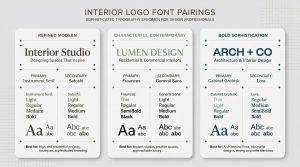
Variable Fonts Revolutionizing Interior Logo Design
The biggest typography development in 2026 is variable fonts. These contain an entire family of styles within a single file.
Why Variable Fonts Matter:
- One file with infinite weight, width, and style variations
- Responsive logos adapt typography automatically
- Animated logos transition smoothly between weights
- Smaller file sizes improve website speed
- Greater creative flexibility with consistent identity
Top Variable Fonts for 2026:
- Inter (versatile, excellent readability)
- Playfair Display (elegant serif options)
- Source Sans 3 (professional, readable)
- DM Sans (modern, geometric, clean)
- Outfit (contemporary, excellent range)
Font Categories for Interior Logo Design
Modern Serifs
Recommended: Fraunces, Instrument Serif, Lora, Newsreader, Cormorant
Best For: Luxury brands, editorial-style branding, established firms
Geometric Sans-Serifs
Recommended: Satoshi, General Sans, Cabinet Grotesk, Switzer, Plus Jakarta Sans
Best For: Modern designers, tech-forward studios
Humanist Sans-Serifs
Recommended: Nunito Sans, Open Sans, Source Sans 3, Figtree, Outfit
Best For: Residential designers, approachable brands
Typography Best Practices
- Use variable fonts for maximum flexibility
- Limit to 2 fonts — one for brand name, one for supporting text
- Test across devices — readable on smartwatches to 4K screens
- Consider accessibility — meet WCAG 2.2 standards
- Design for animation — choose fonts that transition smoothly
- Avoid overused fonts — Helvetica and Montserrat are too common now
- Check multilingual support — important for global markets
- Future-proof your choice — select actively developed fonts
Font Pairing Recommendations
| Primary (Brand Name) | Secondary (Tagline) | Overall Feel |
|---|---|---|
| Instrument Serif | Satoshi | Refined Modern |
| Fraunces | General Sans | Characterful Contemporary |
| Cabinet Grotesk | Lora | Bold Sophistication |
| Cormorant | Plus Jakarta Sans | Dramatic Elegance |
| Satoshi | Newsreader | Clean Editorial |
Step-by-Step Interior Logo Design Process for 2026
Now let’s walk through the actual creation process. This updated workflow incorporates AI tools and 2026 best practices to help you build a professional logo efficiently.
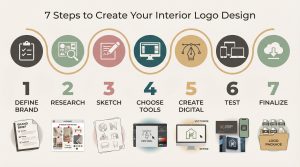
Step 1: Define Your Brand Identity Before Starting Interior Logo Design
Before opening any design software, clearly define your brand. This foundational step determines everything about your final result.
Answer these essential questions:
- What type of interior design do you specialize in?
- Who is your ideal client in 2026?
- What 3 words describe your design style?
- What makes you different from competitors?
- What price range do you target?
- What feeling should clients get from your brand?
- What’s your primary digital platform?
Create Your Brand Brief:
Brand Name: [Your Business Name]
Specialty: [Your Design Specialty]
Target Client: [Ideal Client Description]
Design Style: [3-5 Descriptive Words]
Price Position: [Accessible / Mid-Range / Premium / Ultra-Luxury]
Primary Platform: [Where clients find you]
Competitors: [3-5 Names]
Desired Feeling: [Emotional Response]
Values: [3 Core Values]
Unique Selling Point: [What makes you irreplaceable]
This brief becomes the foundation of your entire branding process. Therefore, invest adequate time completing it thoughtfully.
Step 2: Research and Gather Inspiration
With your brief completed, research existing examples for inspiration. However, research is about understanding possibilities — not copying.
Where to Find Inspiration:
- Pinterest: Search “interior designer branding 2026” and create a mood board
- Behance: Browse professional branding projects
- Dribbble: Discover creative concepts from top designers
- Instagram: Follow #interiorbranding #designerbranding
- Competitor Websites: Study competing firms
- AI Exploration: Use Midjourney or DALL-E to explore visual directions
Collect 20-30 logos, colors, fonts, and images that resonate. Use Pinterest or Figma to organize them into a mood board that guides your design decisions.
Step 3: Sketch and Ideate Your Interior Logo Design Concepts
After researching, begin generating ideas. Even in 2026, great concepts often start as simple pencil sketches.
Ideation Methods:
- Traditional sketching: Draw 30+ rough concepts without judgment
- AI brainstorming: Use ChatGPT to generate concept descriptions
- Mind mapping: Connect brand values to visual elements
- Constraint exercises: Design using only lines, circles, or typography
- Competitive gaps: Explore directions no competitor uses
Common Concept Ideas:
- Architectural elements reimagined as abstract marks
- Furniture silhouettes integrated into letterforms
- Window and door frames as framing devices
- Golden ratio proportions reflecting precision
- Negative space hiding elements within letters
- Continuous line drawings suggesting flowing spaces
Step 4: Choose Your Interior Logo Design Tools
The right tools make the process significantly easier. Here’s the current landscape.

Free Tools
| Tool | Best For | Skill Level |
|---|---|---|
| Canva | Template-based design | Beginner |
| Figma | Vector design, collaboration | Beginner-Intermediate |
| Penpot | Open-source vector | Intermediate |
| Coolors | Color palette generation | All Levels |
Paid Tools
| Tool | Best For | Cost (2026) |
|---|---|---|
| Adobe Illustrator | Professional vectors | $23/month |
| Affinity Designer 2 | Affordable alternative | $70 one-time |
| Vectornator/Linearity | iPad-native design | Free-$10/month |
AI-Powered Tools for Interior Logo Design
| AI Tool | Cost (2026) | Quality |
|---|---|---|
| Looka 2.0 | $30-80 | Good starting points |
| Brandmark AI | $30-200 | Very good |
| Midjourney v7 | $10-60/month | Excellent exploration |
| Adobe Firefly | Included with CC | Very good |
| Kittl | Free-$15/month | Good |
Important: AI tools are powerful assistants but not replacements for strategic thinking. Use them for inspiration, then invest human creativity in refinement.
Step 5: Create Digital Versions
Transform your best concepts into polished digital designs.
Process:
- Set up workspace with brand brief and mood board
- Build top 3-5 concepts starting with black and white
- Test 10+ font options for each concept
- Apply color palette creating variations
- Create responsive versions (horizontal, vertical, icon-only)
- Design animated versions for top 2 concepts
- Test across platforms in mockups
- Gather feedback from 10+ target audience members
- Iterate and refine based on feedback
Essential Rules:
- Create final files as vectors (SVG, AI, EPS)
- Design black and white first
- Ensure readability at 16px and billboard scale
- Create light and dark background versions
- Test accessibility compliance
- Consider circular crop for social profiles
- Plan animation from the beginning
Step 6: Test Your Interior Logo Design Thoroughly
Comprehensively test your design across every application before finalizing.
Testing Checklist:
- ✅ Business card mockup
- ✅ Letterhead and envelope
- ✅ Large format signage
- ✅ Embroidery simulation
Digital
- ✅ Website header (desktop and mobile)
- ✅ Favicon (16px and 32px)
- ✅ Email signature
- ✅ Social media profiles
- ✅ Dark mode compatibility
- ✅ Video watermark
Emerging Platforms
- ✅ AR/VR environment
- ✅ Smart home display
- ✅ Digital business card (NFC/QR)
- ✅ Animated version across platforms
Quality
- ✅ Readability at minimum 16px
- ✅ Circular crop recognition
- ✅ Accessibility contrast compliance
- ✅ Color blindness simulation
- ✅ Grayscale version
- ✅ Reversed version
Step 7: Finalize and Export Your Interior Logo Design
Export in all formats needed for 2026’s multi-platform world.
Required Formats:
| Format | Purpose |
|---|---|
| SVG | Scalable web vector |
| AI/EPS | Vector source files |
| PNG (transparent) | Digital use |
| PNG (dark mode) | Dark background version |
| WebP | Optimized web images |
| Print-ready files | |
| ICO/Favicon | Browser tab icon |
| Lottie/JSON | Web animation |
| GIF | Social media animation |
| MP4 | Video animation |
File Structure:
📁 [Brand Name] Logo Package 2026
├── 📁 01_Vector_Source_Files
├── 📁 02_PNG_Light_Background
├── 📁 03_PNG_Dark_Background
├── 📁 04_Web_Optimized
├── 📁 05_Social_Media_Profiles
├── 📁 06_Print_CMYK
├── 📁 07_Animation_Files
├── 📁 08_Mockups
└── 📄 Brand_Guidelines_2026.pdf
Interior Logo Design Trends Shaping 2026
Staying current helps you create relevant branding. However, always balance trendiness with timelessness.
Trend 1: Kinetic Typography
Moving text creates memorable digital experiences through fluid weight transitions, assembling letterforms, and hover-activated transformations.
Trend 2: Material-Inspired Textures
Logos referencing interior materials are trending — marble veining within letterforms, wood grain patterns, fabric weave textures, and terrazzo elements.
Trend 3: Dimensional Design
Flat design is giving way to subtle dimensionality. Isometric perspectives, soft shadows, layered transparencies, and light source effects create depth.
Trend 4: Inclusive and Accessible Design
Accessibility has moved from optional to essential. High contrast ratios, color blindness testing, dyslexia-friendly typography, and scalable clarity are mandatory.
Trend 5: Sustainable Visual Language
Natural shapes replacing rigid geometry, earth-toned palettes, minimalist designs requiring less ink, and digital-first approaches reducing waste.
Trend 6: Nostalgia Reimagined
Modern reinterpretation of vintage elements — Art Deco patterns with contemporary colors, mid-century typography updated for screens, and heritage formats with minimalist interiors.
Common Interior Logo Design Mistakes Beginners Should Avoid
Learning from these errors saves significant time and money.

Mistake 1: Over-Relying on AI
Accepting AI output without customization produces generic results lacking strategic alignment.
Fix: Use AI for brainstorming, then invest human creativity in refinement.
Mistake 2: Ignoring Dark Mode
85% of smartphone users prefer dark mode. Designing only for white backgrounds is a critical error.
Fix: Design for both backgrounds simultaneously with specific dark mode versions.
Mistake 3: Forgetting Animation
Static-only logos miss engagement opportunities on video-dominant platforms.
Fix: Plan simple animation from the beginning of your process.
Mistake 4: Excessive Complexity
Cramming too many elements creates visual chaos.
Fix: Choose ONE primary idea and execute it beautifully.
Mistake 5: Trendy Over Timeless
Following every trend creates logos that date quickly.
Fix: Build on timeless principles. Ask: “Will this work in 2036?”
Mistake 6: Neglecting Responsive Design
A single version for everywhere doesn’t work in 2026.
Fix: Create a complete system with multiple optimized versions.
Mistake 7: Skipping Strategy
Jumping into tools without strategy creates directionless results.
Fix: Complete your brand brief first.
Mistake 8: Ignoring Accessibility
Beautiful designs that fail compliance standards create legal and ethical problems.
Fix: Test contrast, color blindness, and readability throughout the process.
Interior Logo Design for Different Specialties
Different specialties require tailored approaches to branding.
Residential Design Branding
Warm palettes, friendly typography, subtle home references, Instagram-optimized versions.
Commercial Design Branding
Confident palettes, geometric sans-serifs, architectural references, LinkedIn-optimized versions.
Hospitality Design Branding
Muted luxury palettes, elegant typography, experience-driven elements, animated social versions.
Sustainable Design Branding
Earth palettes, organic typography, biophilic elements, authentic purpose-driven feel.
Virtual and AI-Integrated Design Branding
Tech-forward palettes, modern geometric fonts, futuristic elements balanced with warmth, AR-optimized versions.
Building Brand Guidelines After Interior Logo Design
After finalizing your design, brand guidelines ensure consistent usage everywhere.
Essential Sections
1. Logo System Overview
Document primary, secondary, icon-only, wordmark, responsive, and animated versions with clear usage rules.
2. Color Specifications
Primary: Warm Charcoal
HEX: #2D2926 | RGB: 45, 41, 38 | CMYK: 0, 9, 16, 82

Secondary: Sage Green
HEX: #9CAF88 | RGB: 156, 175, 136 | CMYK: 11, 0, 22, 31

Accent: Soft Gold
HEX: #C5A47E | RGB: 197, 164, 126 | CMYK: 0, 17, 36, 23

Background: Warm White
HEX: #F5F0EB | RGB: 245, 240, 235
3. Typography Standards
Primary: Instrument Serif (Variable, 400-600)
Secondary: Satoshi (Variable, 300-700)
Fallback: Georgia, serif / system-ui, sans-serif
4. Digital Specifications
Document requirements for website, social media, email, and emerging platforms.
5. Animation Guidelines
Duration: 2-3 seconds | Style: Subtle reveal
Formats: Lottie, GIF, MP4 | Frame rate: 30fps
Interior Logo Design Cost Breakdown for 2026
Understanding pricing helps you make informed decisions.

| Approach | Cost Range | Quality | Turnaround |
|---|---|---|---|
| DIY (Free Tools) | $0-50 | Variable | 1-7 days |
| AI Generator Only | $30-200 | Moderate-Good | 1-4 hours |
| AI + Human Refinement | $200-800 | Good-Very Good | 3-7 days |
| Freelance (Budget) | $200-800 | Good | 1-2 weeks |
| Freelance (Mid) | $800-3,000 | Very Good | 2-4 weeks |
| Design Studio | $3,000-15,000 | Excellent | 4-8 weeks |
| Premium Agency | $15,000-75,000+ | Premium | 8-16 weeks |
Best Value: AI-Human Hybrid
- Generate 50-100 AI concepts ($10-50)
- Select top directions based on strategy
- Hire designer to refine ($200-500)
- Create complete file package ($100-300)
Total: $310-850
Digital Platform Optimization for Your Interior Logo Design
Your visual identity must perform flawlessly across every platform.

Website
- SVG for scalability, inline for speed
- Automatic dark mode switching
- Under 20KB file size
Social Media Sizes
| Platform | Size | Tips |
|---|---|---|
| 320 x 320 px | Icon version, high contrast | |
| TikTok | 200 x 200 px | Bold, simple |
| 165 x 165 px | Clear at tiny sizes | |
| 400 x 400 px | Professional version | |
| YouTube | 800 x 800 px | Any background |
Emerging Platforms
Create 3D-ready versions for AR/VR, register with AI assistants, and optimize for digital business cards.
Complete Interior Logo Design Checklist for Beginners
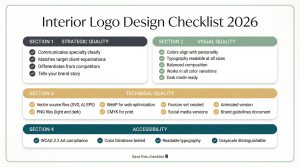
Strategic Quality
- ✅ Communicates specialty clearly
- ✅ Matches target client expectations
- ✅ Differentiates from competitors
- ✅ Tells your brand story
Visual Quality
- ✅ Colors align with personality
- ✅ Typography readable at all sizes
- ✅ Balanced composition
- ✅ Works in all color variations
- ✅ Dark mode ready
Technical Quality
- ✅ Vector source files
- ✅ PNG (light and dark)
- ✅ WebP for web
- ✅ CMYK for print
- ✅ Favicon set
- ✅ Social media versions
- ✅ Animated version
- ✅ Brand guidelines
Accessibility
- ✅ WCAG 2.2 AA compliance
- ✅ Color blindness tested
- ✅ Readable typography
- ✅ Grayscale distinguishable
Frequently Asked Questions About Interior Logo Design

What makes a good interior logo design in 2026?
A good logo for interior designers is simple, memorable, versatile, accessible, and strategically aligned with your brand. It should communicate your style, work across all platforms, include animated versions, and meet accessibility standards.
How much should I budget for interior logo design?
Your budget depends on business stage. Beginners can start with $200-800 using the AI-human hybrid approach. Established firms should invest $3,000-15,000. View it as a long-term investment lasting 7-15 years.
Should I use AI for interior logo design?
AI is excellent for brainstorming and generating concepts. However, relying entirely on AI produces generic results. The best 2026 approach combines AI inspiration with human creativity for strategic refinement.
What colors work best for interior logo design?
Warm charcoal, sage green, soft gold, dusty rose, and deep teal dominate current trends. However, choose colors based on strategy rather than trends alone.
Do I need an animated version?
In 2026, animated versions are strongly recommended. Video dominates social media, and motion logos capture 3x more attention. Even a simple 2-3 second animation enhances your digital presence significantly.
What file formats do I need?
You need SVG for web, AI/EPS for sources, PNG for digital (light and dark), WebP for optimized web, PDF for print, ICO for favicon, and Lottie/GIF/MP4 for animation.
How often should I update my interior logo design?
A well-designed brand mark lasts 7-15 years. Minor refinements every 3-5 years keep it current. Complete redesigns should only happen during fundamental repositioning.
What’s the biggest interior logo design mistake?
Over-relying on AI without brand strategy. Many beginners accept the first decent output without considering unique positioning. Always start with strategy before design.
How do I ensure accessibility?
Meet WCAG 2.2 AA standards with 4.5:1 contrast ratios. Test with color blindness simulators, choose readable fonts, and maintain clarity at small sizes.
Can I trademark my logo?
Yes, you should trademark your brand mark. Filing costs $250-500 and provides legal protection. Consult an intellectual property attorney for guidance.
Conclusion: Start Your Interior Logo Design Journey Today
Creating a professional logo for your interior design business in 2026 is one of the most important investments you can make. A great logo communicates expertise, attracts ideal clients, builds recognition, and works seamlessly across every platform.
Throughout this guide, we’ve covered everything you need:
- The 2026 landscape — How AI, platforms, and accessibility have transformed branding
- Modern styles — From neo-minimalism to animated logos
- Color psychology — Warm charcoal, sage green, and soft gold for emotional impact
- Typography — Variable fonts and modern typefaces for distinction
- Proven process — Step-by-step from strategy through final export
- Current trends — Kinetic typography and dimensional design
- Critical mistakes — Including AI over-reliance and accessibility neglect
- Platform optimization — From smartwatches to VR showrooms
The tools available in 2026 make professional branding more accessible than ever. However, the fundamentals remain: great design starts with clear strategy, thoughtful creativity, and meticulous attention to detail.
Start with your brand brief today. Explore concepts tonight. Sketch ideas this weekend. Take the first step toward a visual identity that transforms your business.
Your dream brand is waiting. Let’s make it happen.
Found this guide helpful? Share it with fellow designers building their brand in 2026.